Error pages
Traefik's own errors are a bare 404 page not found or Bad Gateway. Homerun
replaces them with a branded page, so a visitor who arrives early or while an
app is down sees something that says what's going on.
#What shows when

- Not available yet (404): the address belongs to one of your services, but nothing answers on it, because the service is still deploying for the first time, or it's stopped. The page says the app is on its way.
- Nothing here (404): no service uses the address at all.
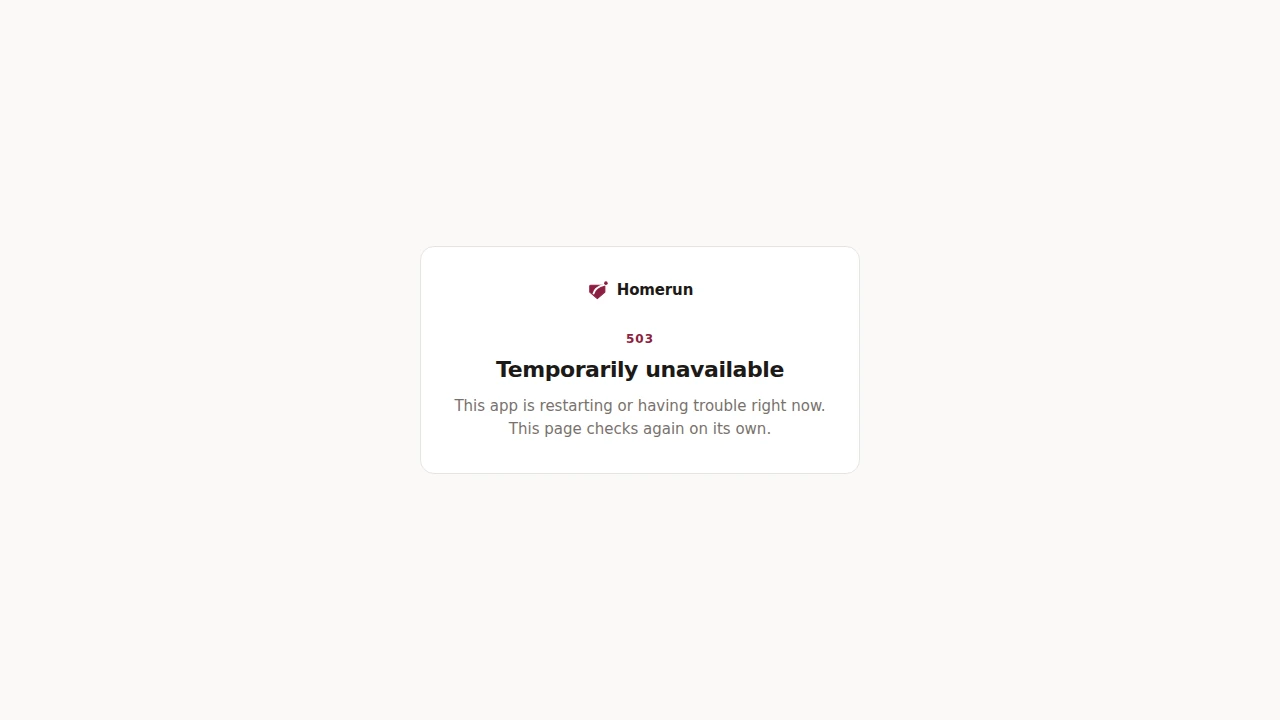
- Temporarily unavailable (502, 503, 504): the app's container exists but can't answer, because it crashed, it's restarting or it timed out.
- Blocked path (403): the path matches one of the service's blocked paths.
- Waking up (503): the service was put to sleep by scale to zero and is starting again. Most visitors never see it: their request waits for the app and lands on it.
The "not available yet" and "temporarily unavailable" pages reload themselves every 15 seconds, and "waking up" every 2, so a visitor lands on the app once it's up. An app's own error pages are left alone: its 404s pass through untouched, and only the three gateway errors are replaced.
#Branding and text
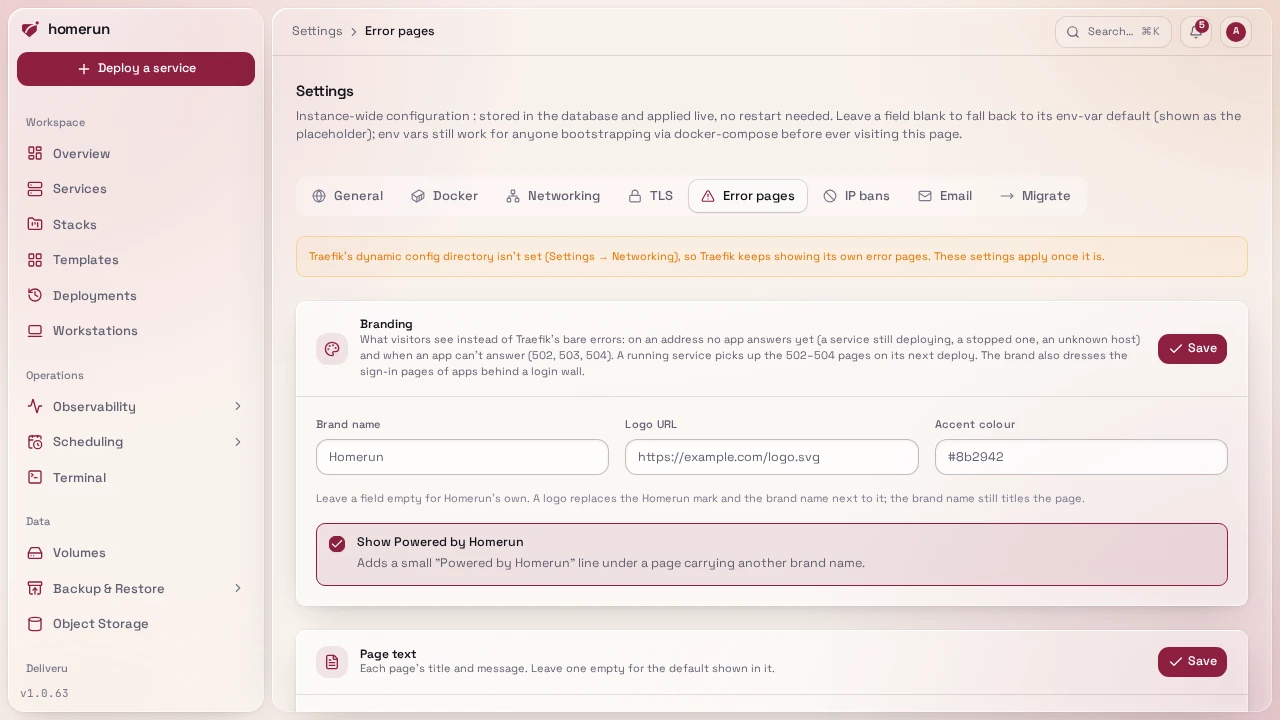
Settings → Error pages sets the brand name, a logo URL (replacing the Homerun mark), an accent colour, and each page's title and message. Leave a field empty to keep Homerun's own. With another brand name, a small "Powered by Homerun" line shows under the page unless you turn it off. Each page has a Preview link.
The same brand name, logo, accent colour and "Powered by" line also dress the sign-in pages of an app behind the login wall, so a visitor never sees Homerun's name between your app and its sign-in. The dashboard's own sign-in stays Homerun's.
From Terraform, homerun_error_pages sets the same fields, the page texts as a
page_texts map (notFoundTitle, notFoundMessage and so on), see
Infrastructure as code.
#How it works
Homerun writes homerun-error-pages.yml into Traefik's dynamic config directory
(Settings → Networking). It holds:
- a catch-all router at the lowest priority, so any request no other router claims (a host no running service routes) gets the 404 page;
- an
errorsmiddleware that swaps a 502, 503 or 504 for the matching page; - the middleware a service's blocked paths go through to reach the Blocked path page.
Every service deployed since carries that middleware. A service that was already running picks it up on its next deploy; until then, Traefik's own gateway errors still show for it, while the 404 pages work for every host straight away.
A service's DNS record (or Pangolin resource) is created when its deploy starts, not when it finishes, so the address already reaches Traefik, and the "not available yet" page, while the first deploy builds.
Without a dynamic config directory, nothing changes and Traefik keeps its own pages. On a fresh hostname with no certificate yet (one issued over the HTTP challenge), the browser warns about the certificate before showing the page; a wildcard certificate for your base domain avoids that.
This guide lives in the project repo: edit it there, and this page follows with the next release.